
Home » Susie Rinehart » Page 12

Tag: Susie Rinehart

How to Strengthen your Marriage; Send the Kids to Camp

Since the kids left for camp three weeks ago, I’ve done laundry once. I haven’t yet turned on the oven. I cooked one large batch of red-lentil curry and we have been eating that every day. When I clean the house, it’s still clean the next day. Phone chargers and scissors stay where I put them. There are no arguments about screens and bathrooms. Our home feels less like a train station and more like a quiet, tidy oasis. But that’s not the best part. The best part is I get to reconnect with my husband.

At first, it was too quiet. Our conversations were awkward. With the kids gone, there were no logistics. With no logistics, there was nothing to talk about. For years, I’ve believed that our communication was less than great. Now I don’t think it’s terrible; I think we were just out of practice.

We had to slowly get to know one another again. I finally learned what Kurt does for a living as a data scientist. And I re-learned that he needs me to sit and look right at him when he speaks, in order to feel heard. In the beginning, we fought more, not less. There were no kids around to keep us from arguing. But there were also no interruptions. So we kept talking until we got to the bottom of what was bothering us, and came to a place of deeper understanding.

When our kids were eight and ten, we made them try two weeks of sleep-away camp. We ask them each year if they want to go back, and so far, the answer has been an enthusiastic, Yes! This year and last, they have gone for one month. Our son, fourteen, goes to the same camp I went to as a teenager: one that is big on rugged camping and not much else. He’ll spend over twenty days canoeing a remote river, in northern Ontario, learning to navigate rocks and rapids, fears and friendships. Our daughter prefers to go to an all-girls camp with her cousins and the daughters of my childhood friends. She gets to sail, swim, do archery, and perform in the summer musical. They don’t have phones or screens of any kind. Mail is slow, so we rarely hear from them. Yet we know that they are being cared for by many, capable adults, so we don’t worry. This time away is good for them. It is also good for us, and our marriage.

[bctt tweet=”Sometimes I make the mistake of believing that the bond with my kids is the most important relationship. But in a few years, the kids will be grown and gone. Then what? ” username=”susie_rinehart”]

This month, our relationship has a certain quality of attention: we are less needy and more curious. We head to the mountains to hike as fast as we want, identify wildflowers by their latin names, and fish in high alpine lakes. For us, with the kids away, it’s less like we’re wild twenty-somethings, and more like we’re two souls protecting one another’s solitude. I read, and Kurt learns to play the drums. I go dancing, while he heads out on a bike ride. After dinner, we jam a little: Kurt on the guitar and me on the banjolele, and we fantasize about having a family band when the kids come back.

Sometimes I make the mistake of believing that the bond with my kids is the most important relationship. But in a few years, the kids will be grown and gone. Then what? I don’t want to wait to find out. I want to hold my sweetheart’s hand now with a long afternoon before us, and toast how far we’ve come, how far we’ll go, together.

Love,

Susie

***

photo credit: Susana Fernandez, Flick’r
 

I did something scary for my birthday

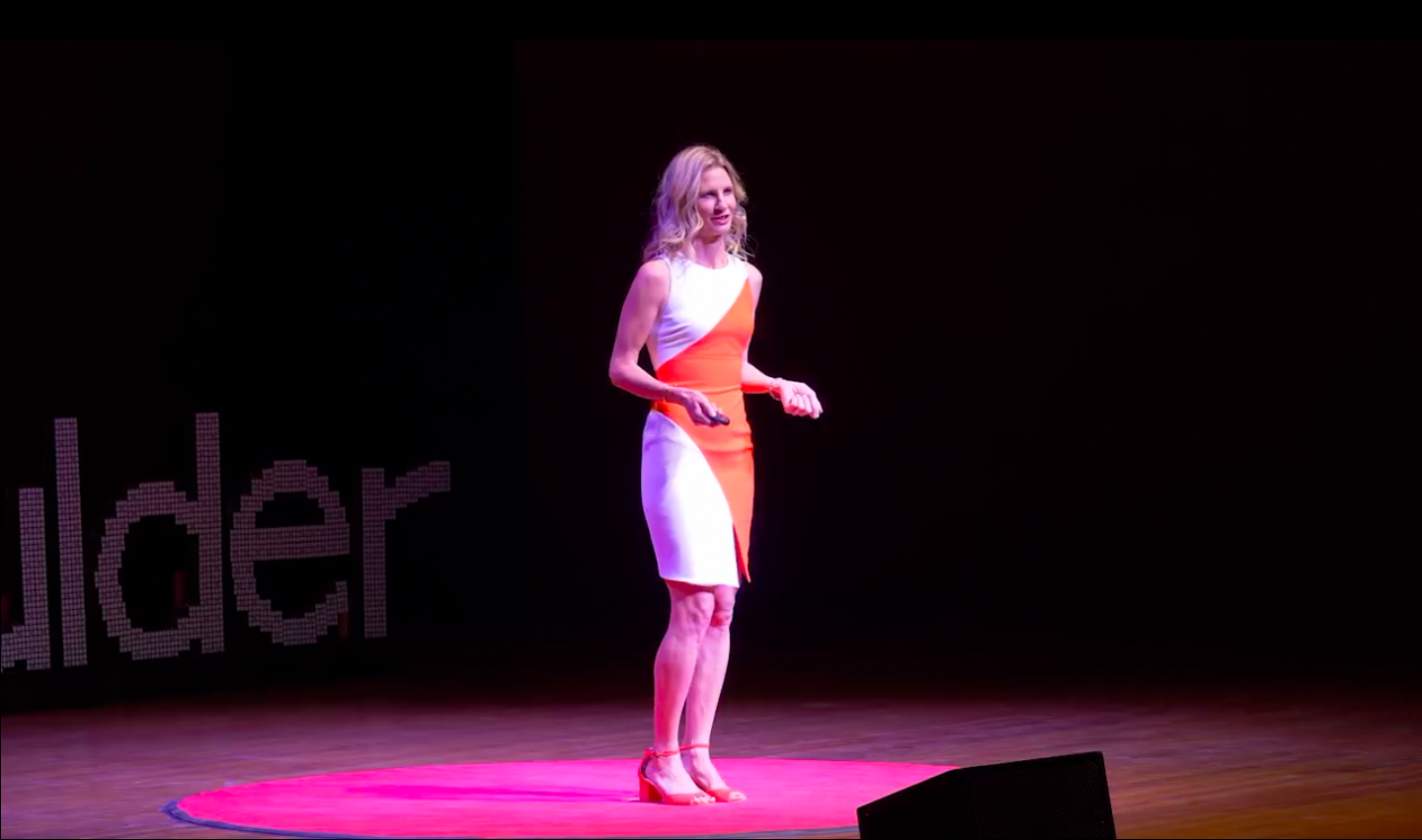
I am thrilled to share my recent talk from TEDx Boulder in June. Grab some popcorn for an 8 min ride! I always do something scary for my birthday, but usually it involves running a race over high mountain passes. This time, the mountain I had to climb was facing my fears and 1,500+ people, to tell my story. I never expected what happened. The energy that night was so incredible and positive that I want to share it with you.

May this video be a match strike for your courage to face a challenge, have that tough conversation, or begin something bold.

College Reunion Anxiety & What I Learned by Going

Why was I so nervous? I hadn’t been a terrible person or horrible student in college. But I couldn’t shake the worry about returning to my small college in New England for our twenty-fifth-year reunion.

Maybe the doubt came from shouldering all the insecurities of my twenty-year old self PLUS the new ones of my middle-aged self. Did I belong? Had I achieved enough? Will I look wrinkly and tired?

Maybe it was because twenty-five years ago, I was convinced that the admissions office had made a mistake. I am not smart enough or talented enough to be among these prep school geniuses and athletic giants. This time, I arrived on campus with a wheelie suitcase instead of a duffel bag, but the feeling was the same as when I was eighteen. Except now I was sure I was the one who had made the mistake. Why did I come back?

It didn’t help that within hours of graduating so long ago, I was in a car headed north to Canada, where I was born. The border itself confirmed the feeling I had of a solid line between my experiences in college and those after. I was foreign, an alien. My visa expired. I was not really welcome back.

But within minutes of returning to campus, I was swept up in hugs given by people I had not seen since “Jump Around” was the new hit single. No one measured successes or counted failures. No one took score on careers, kids, or real estate. No one scolded me for not keeping in touch.

Our conversations went straight to the heart. A woman I thought was perfect shared stories of raw pain, another of the grief around the death of her Dad, another of the loss of his job and identity. We were unguarded and vulnerable. And that opened the door for a ton of simple, fun moments.

We rode around in the back of a pick-up truck and the years between when I was twenty and forty flew through my hair and vanished. We bushwhacked through the forest to find waterfalls and jumped into swimming holes off granite ledges. We laughed easily and often over creemees from the local ice cream shop. We gathered around a ping pong table in an empty parking lot until two in the morning because no one wanted to leave one another’s side. We didn’t want to miss a moment of being together, no matter how cold the night air, or how often the campus security wondered, “Surely you have somewhere else you can go?”

The nervousness I felt so strongly before the reunion fell away as we looked up at the stars. We remembered and named the constellations. Then we remembered and named those who didn’t make it back and those who couldn’t because they had died too young. And when we gathered in the college chapel with our professors and those who were returning after five, fifty, even seventy-five years, we found common ground among a mix of generations and backgrounds. We shared a love of wildness and wilderness, intellectual debate, and swinging for the bleachers in life.

There are many times over the years when I have felt lost. But during this reunion, I felt found. I stopped trying to fit in and I let myself belong.

It turns out, others were feeling anxious before coming, too. What did it take to get us to the reunion? Only one person reaching out and saying, I really want to see you again. I wonder how many other things I’ve been nervous about or avoided because I was sure I didn’t fit in? I just have to remember that this is how it goes. Those fears I felt in the beginning are just telling me I’m doing something, and not that I’m doing something wrong.

Love,

Susie

****

The Loneliness of the Injured Distance Runner

“You’re breaking my heart! Can’t you run on another street? I’m injured!” That’s what I want to shout to the runners who innocently stride by our house. Instead I wave half-heartedly. Like anyone who has been injured or who has had to redefine themselves after they could no longer do a sport they loved, I feel a mix of envy and sadness when they run past me. I too want to be training for something exciting. I too want to feel that runner’s high. I’d like to at least jog a fun run with my kids. But I can’t.

Since the operations two years ago on my head and spine, my surgeon says, “No running.” My surgeon isn’t cruel; he just knows that it isn’t good for me. My spine is fused from my skull to my shoulders. It is held together with metal rods and screws. Running could loosen that hardware, or break it. So I listen to him. But not being able to run makes me feel small.

Who am I if I’m not a runner? My identity as a runner goes as far back as third grade when I beat all the boys in the class at the 100 meter dash. I found something that I was good at, and then wore my blue, polyester Adidas tracksuit every day through third and fourth grade. In high school and college, I set records in the mile and half mile. Then, after I graduated, I kept running marathons and ultramarathons, because running is where I counted exhales instead of minutes on a clock in a conference room. Out running, I felt a sense of progress and of possibility.

Just weeks before the surgeries, I ran an ultramarathon in the rocky mountains and won the Masters division. I felt invincible, capable of anything. After the fusion, I was not handling the loss of running well.

Until recently, when I decided to try on a new perspective: What are the elements of running that I love?

Top of the list is being outside, on a trail. Can I still do that? Yes! Now I go on slow, daily rambles. I shift my gaze from the roots and rocks to the tops of the trees and I am learning to identify birds. I love the way it looks when hummingbirds shake off raindrops from their wings; I’d never noticed that before.

Next is the “body high” after a workout, that elation from moving fast and hard. I don’t quite get that feeling doing leg raises at the physical therapist’s office. But I recently “graduated” from PT, so I am exploring new ways to move my body. I’ve been dancing. Not very well, but still. As long as I don’t try any Baryshnikov leaps, I’m safe. I’m also swimming. But because I can’t turn my head to the side, I swim with a snorkel. The little kids think I’m cool. The adults don’t ask questions. 

But it’s not the same. It’s lonely. One of my favorite things about running is the other runners. I have always loved my morning conversations with friends and training partners. We talked about everything, from favorite places to how to survive graduate school or divorce. I always came home feeling better, like I wasn’t alone in this uncertain world. I realized it wasn’t helping to isolate myself just so I wouldn’t have to hear about their training adventures. So I’m fighting the loneliness by volunteering more.

At first I thought it would depress me to be on the side of the race course instead of in the middle of it, but it doesn’t. It brings me back in touch with a tribe I love, the conversations that move me, and a passion that is still mine. You’ll see me out there, early morning, waving you into a parking space, or handing out water at an aid station.

Finally, I had to face the truth that I thought my ability to run more than thirty miles, no sweat, was evidence that I had a superpower. It’s what made me different. I wondered, Without my ability to run, How am I extraordinary? But I had the question backwards. Why not ask, How is the world extraordinary?

Now, I slow down. I notice those wings of a hummingbird after a rain, the smell of butterscotch in a ponderosa pine, and I go for walks with my neighbor who is also feeling lonely. Life is not about the world celebrating me. It’s about me celebrating the world.

I lost something important to me, but I found unexpected joys. Now I wave to the runners on my street and mean them well. I think, I’m with you on this workout. I know it’s tough for the first mile, but hang in there. It gets easier.  

***

Super Simple Tips for Positive Change

We’ve spent hours making piles of clothes, books, and things in the house. The piles represent the stuff we want to toss, give away, or keep. Spring is the season of decluttering. While I don’t love the mess, I love the feeling when it’s done; I feel more relaxed, clear, and joyful when there is less stuff to cloud my view. A friend of mine is also doing a detox to clean out winter’s heavy wine and cheeses from her body. I am inspired to do a detox of another type: cleaning out self-criticism and negativity.

The most important detox I do regularly is to rid myself of negative thinking. I’ve written about the benefits of self-compassion before. This time I want to give you my map to freedom from thoughts that make me anxious and lonely. These are the kind of thoughts that say, “I’m not enough” or “I’m letting everyone down” or “I’m trapped in this life” or “the world is not safe and people are cruel.”

5 tips for a negative-thinking detox to bring about positive change:

  1. Stop planting negative seeds. Don’t turn on the news until after 12 noon. Headlines feed fear in our minds and make us feel frantic, not free. When I drive, to avoid the tendency to turn on the radio, I turn on a playlist of songs before I get in the car. Lately, I’m loving Nina Simone’s 1965 classic, “Feeling Good.” Her soulful voice and lyrics get me going in a good direction. She belts out, “It’s a new dawn, it’s a new day, it’s a new life for me…and I’m feeling good.”
  2. Start planting positive seeds. Commit to two things that bring you home to yourself and do those first. For me, that’s meditating and being outside. I dedicate my first 11 minutes out of bed to sitting quietly on a cushion on the floor next to my bed, listening to the birds out the window, saying a few mantras I like, plus a few gratitudes, and breathing deeply. Then I step outside and walk around the block, looking for signs of spring. I get up earlier to do these things because then I feel grounded for the rest of the day. I make decisions from a place that feels less like a bouncy castle and more like home. As Trista Gipple says, “The universe is on your side. It has all these gifts it wants to share with you, but you have to be home to receive them.”
  3. Use a gentle voice when talking to yourself. In the evening, try asking yourself, “Where did I make progress today?” instead of “What did I get done today?” And when you hear the dictator in your mind start telling you, “You’re worthless. Why can’t you get more done in a day?” Don’t reject the thought, just refocus. Drop into your senses and feel your fingertips. Or give yourself a pep talk. Try saying, “You are smart, capable, resourceful. Many people have your back. You are not alone. In fact, who can you call to ask for help tomorrow?”
  4. Make a list of the things you dread, and then organize the list into piles: toss, give away, keep. Martha Beck, Oprah’s coach, calls this practice, “Bag it, Barter it, Better it.” If something has been on your to-do list for weeks, get rid of it. You can toss it (bag it), or explore how to give it away by getting someone else’s help (barter it), or keep it, and remember how you got through something difficult and similar before and use those techniques to cross it off your list finally (better it).
  5. Set boundaries defined by joy. This spring, choose joy over fear when it comes to social obligations. Ask before accepting each invitation, “Will I be happy with my decision?” Don’t mess around with social things that don’t make you healthy and happy.

When you’ve tried all these and you feel like giving up, help someone else. Lend a hand and you will get a second wind and a rush of positive feelings. Don’t turn this into another big item on your to-do list, just think of one small way you can help someone feel a little less alone and do it. Nothing clears negative thinking away faster than a little positive company.

Here’s to a healthy, happy you.

Love,

Susie


Take your detox to the next level

In the Brave Over Perfect coaching group, we are doing a stress detox together. Our next live call is Wednesday, May 9 (you can listen to the recording anytime). Throughout the month, Christine Carter will be teaching research-based techniques for dialing back the stress of our modern lives.

Join now for instant access to the Spring Stress Detox study guide and three live coaching calls. All three calls plus tons of resources are just $20. Learn more or enroll now.

photo credit: U.S Dept. of Agriculture

CAN vs USA; ME vs HIM

We sat side by side on our couch, enthusiastically cheering for opposite teams during the gold medal Women’s hockey game. I was screaming at the Canadian women, “Set up and SCORE!” My husband, Kurt, was chanting “USA! USA!”

I am competitive. I am also Canadian, born and raised in Toronto. My husband is American, born and raised in Des Moines. Neither of us likes to lose. But for some reason, his rooting for a different team was getting under my skin. Kurt doesn’t even care about hockey. He should be cheering for Canada to support me. He should always have my back.

My husband wasn’t doing anything wrong. In fact, he wasn’t doing anything at all. He was literally just sitting there, cheering on his country. But I took his stance personally. I felt like he was cheering against me.

Fine, I thought. If he is going to cheer for USA, then prepare to be crushed.

Many of you know the outcome of the game: Tied up in the 3rd period at 2-2, the gold medal final went into sudden death overtime. After twenty minutes of 4-on-4 play, the score was still tied at 2-2. Then everything stopped while they re-surfaced the ice before a shootout. In a shootout, one player skates with the puck straight at the goalie. “Nail-biting” isn’t dramatic enough to describe the tension. It felt more like “arm-biting” or “arm-and-leg biting.”

Each team gets five chances to score a goal, what officials call “a winner.” This time, at the end of ten shots, both teams scored the same number of winners. The game was still tied.  

By now it was 2:30 in the morning in Toronto, and past midnight in Boulder. Kurt and I were no longer looking at each other or speaking to one another. We were leaning forward with the skaters, and diving for pucks with the goalies. Then they began a second, sudden-death shootout: five more shots on goal each. Finally, the American women scored one more goal than the Canadians. Game over. USA won the gold.  

I slammed the door. I stomped around the house. I turned to my husband and said, “You’re American and all Americans are obnoxious.”

“What?” He looked at me, concerned. The “polite and friendly” Canadian was yelling aggressively, and stereotyping her own husband.

In that moment, I felt angry and helpless. When I feel helpless, I attack. When I feel empowered, I connect with others. Note to self for the future: Can I create a feeling of empowerment by deliberately connecting with others, rather than letting helplessness take over my body and my voice?

Kurt was just doing what he always does: cheering for the underdog. This time, the underdog was the United States. When I make my husband stand for all men or all Americans, I objectify him. But I don’t ever want to be objectified. I have to be able to empathize with him on a calm, sunny morning, and also during moments of high stress, if I expect to be treated with respect and compassion.

He wasn’t cheering against me; he was just being him. I want to let go of my expectation that unified means “the same.” Kurt doesn’t have to be the same as me or the same as some fantasy husband to be the right guy for me. We are different. I want to let him be who he is and be fully who I am. If I begin there — we are different — there is a better chance of us finding our unique ways to battle life’s struggles with unified force.

Love,

Susie

***

How much can we really expect of our spouses and still be happy?  If expectations create relationship-killers, like nagging, contempt, and criticism, how can we respond constructively when our expectations aren’t met?

 Learn more or enroll now. 

Our next group coaching live call is Friday, March 16. We’ll be digging deeper into the misery of high expectations, and more specifically what to do when our partners don’t measure up.

Join now and you can listen in to our March 2nd recording and get instant access to all of our Love & Marriage online resources.

(photo credits: Usman Malik/Flick’r & Jamie Squire/Getty Images)


The Solution is Not Self-Help

I should have sent this post out before Valentine’s Day. Stupid. Stupid. Stupid. I should be more focused. What’s wrong with me?

Earlier, I passed a neighbor in the grocery store and she looked at me strangely. I immediately went to the first seven things I must have done wrong. Am I wearing pants? Did I not respond to an email? Was I supposed to pick up her daughter? Did I forget her birthday? Is she sick and I didn’t reach out? Did I talk too much last time I saw her? Am I supposed to somewhere else?

I have an inner critic who takes her job really seriously. She has me thinking, I’m selfish. I’m lazy. I’m distracted. Floral, Hawaiian pajamas are not okay to wear to the store.

Turns out, my neighbor didn’t even notice my pajamas. And I didn’t forget her birthday or her daughter. She forgot her glasses at home. She wasn’t looking at me strangely. She was just squinting, because she couldn’t see.

This month, I am learning to be kind to myself. Kristin Neff, a psychologist and researcher out of the University of Texas in Austin says that self-compassion is really no different from compassion for others. When you notice that someone is hurting, like the Olympians who fell during their figure skating routines, your heart responds with care and tenderness. You want to offer kindness to them instead of judging them harshly. Self-compassion suggests that we act the same way towards ourselves when we make mistakes or notice something we don’t like about us.

Too often, we don’t just say, “I did that wrong,” we say, “I’m wrong.” So how do we stop being so self-judgmental?

My friend and I signed up for a self-compassion class with a yoga teacher we both love.

“What did you get out of it?” I asked my friend.

“I don’t know. I spent the whole class thinking, I’m an idiot. I wore jeans to a class in a yoga studio.”

This is not a post about how we have to love ourselves first before we can love another. If that were true, I am not sure there would be any couples in the world. This is about how we can never really relax if we are always trying to fix who we are. The solution is not self-improvement; it is self-compassion.

This month, my goal is not to end the critic’s monologue in my head, because I am not sure that is possible. All I want is to catch her unkind thoughts faster, recover quicker, and not spin out so often.

We can’t make the negative, critical thoughts go away. We can practice First-Aid: apply pressure with both hands to the bleeding places and hold steady. Say, “Ouch.” Say, “Suffering is a human experience.” By thinking about how others are suffering at this same moment, we gain perspective. We step out of self-pity and into our common humanity. Finally, we give ourselves kindness and say, “I’ve got your back.” If we don’t have our own backs, no one else will.

When my friend admitted that she couldn’t stop thinking about how stupid she was to wear jeans, the teacher, Taylor White Moffitt, told the story of a southern woman she knew who would stop when she heard her inner critic and put her hands over her heart. Then she’d say with tender empathy to herself, “Oh, Darling! You’re suffering, that’s all.”

Today I accept that I am a contradictory, confusing creature. I scribble down these words in my journal:

This is who I am: I am lazy and I am disciplined. I am distracted and I am focused. I am a mess and I am inspiring. I am selfish and I am thoughtful. I have a bad temper and I am calm. I am fragile and I am strong. Oh, and I am a person who thinks floral, Hawaiian pajama bottoms are pants. This is who I am.

But even now, my inner critic is saying, “This blog post is very late.” So excuse me a minute while I stop, put my hands over my heart and say, “Oh Darling!”

Love,

Susie

Interested in finding a more lasting happiness? We hope you’ll join our Brave Over Perfect Group Coaching community. Our March theme is all about how to love and be loved. It’s only $20 to join us! Get instant access to three live coaching calls (and call recordings), a thriving online community, and online resources. Learn more or enroll now.

photocredits: Roses: LaSara Flick’r, Inner Art Critic: Slimdandy, Flick’r

***

I follow Ben Franklin’s morning routine. Here’s why.

When I think about the future, it’s tempting to think we’re going to hell in a handbasket. But I’d be wrong. There are innumerable ways to make the world better. One is to start the day with a morning routine that asks a powerful question.

Humans have always felt that the good days are behind them and the times they are living in must be the worst. Ask the mothers of the middle ages when the plague killed twenty-five million people. Ask the generation of the late 1960s when they lived through the assassinations of Martin Luther King Jr., both Kennedy brothers, and an endless war in Vietnam. Is it really true that this is the worst time?

Maybe believing that we are living in terrible times makes us feel important. Or maybe we think it is motivating to believe things are bad and getting worse. I used to think that if I stopped feeling angry about the state of the world, I would stop caring. I pictured myself on the couch, feet up, eating bonbons. But not anymore. I know that anger works like sugar to give me a short burst of adrenaline, but I end up feeling depressed and helpless. Now I know that there is a motivator that is stronger and more lasting than anger. How can I believe that things will improve?

Let me tell you about a conversation I just had with friends in California. We were visiting them in Santa Barbara, over New Year’s, in the wake of the largest wildfire in the state’s history and right before the devastating mudslides. These dear friends, Linda and Tom Cole, have dedicated their lives as Humanitarian Aid workers in post-war regions of Africa. When things can’t possibly get worse in South Sudan or Uganda, they call Tom and Linda. The two of them match local knowledge with education to grow food and wealth in and out of refugee camps.

We ate dinner together. I was feeling pessimistic, a little depressed by the sight of black, lifeless hillsides after the fires. Then another friend at the table asked Tom and Linda about their vision of the future,

“Where do you stand on the spectrum of things are going to be great to things are going to be terrible?”

“I don’t ever really think about that,” said Tom without hesitating.

“C’mon–how can you not feel that things are getting worse and worse?”

“I see people, with 1-5% of the resources we have, waking up every morning, brushing themselves off, and walking forwards, prepared to do whatever it takes to make life a little better. If they can do it, we can too,” said Tom.

That conversation has me thinking. When we get up in the morning, we do what we can to make the future better for us and for our children. When things change, when we have fewer resources and comforts, will we just give up? Stop working to make the world better? I don’t think so. Yet most people, when pressed, are pessimistic about the future.

What works for me to take positive action is to ask this one question every morning: “What good shall I do this day?” And then I identify something small and doable to say out loud: “Write a letter to Moustapha.” (He is a friend who lost his house in the fire in Ventura, CA.) But my answer could be, “Be kind,” or “Call a friend in need.”

I stole the question from Benjamin Franklin. He kept the same daily schedule for years and documented it. This is what he writes about his morning routine, “Rise, wash, and address Powerful Goodness. Take the resolution of the day…and breakfast.” In bed by 10, he asked every night, “What good have I done this day?” Here’s the catch: it doesn’t work if you beat yourself up for not doing enough good. Because, as Jack Kornfield said, “If your compassion does not include yourself, it is incomplete.” (If you find you keep falling short of “doing good,” your daily goal might be too big. Be kind to yourself and make it smaller. For ex) “I will write the first sentence of that letter to my friend in need.”)

I love the questions, but I love the phrase Powerful Goodness even more. It names the feeling I have when I think of Tom and Linda. It names the motivating force I feel when I think of our kids. The future is made from millions of immeasurable moments of Powerful Goodness. So forgive me, I have to go now. I have a letter to write and breakfast to take.

Love,

Susie

(photo credits: featured photo: Kevin Thomas, Flickr. Schedule: Lifehack.org)

***

If this post resonates with you, I hope you’ll join our Brave Over Perfect group coaching! Our March theme is all about love and marriage. We’ll show you how to transform even the most challenging relationships, and it’s only $20 to join us for three coaching calls. Get instant access to our group coaching calls (and call recordings), a thriving online community, and online resources. Learn more or enroll now.


Murder, Mystery, & Magic

I am a big fan of mystery and magic. I want our children to grow up unafraid of the unknown, even relishing it. When my daughter asked me to write a murder mystery birthday party for 12 of her closest friends, I responded too quickly, “Of course!” Here is a brave over perfect opportunity!

I’ve never written a murder mystery. I’ve never been to a murder mystery party. And the last time I watched “Murder She Wrote,” I had feathered hair and wore blue eyeliner, which is to say, a long time ago. Then I thought, this is not brave. This is stupid. 

“How hard can it be?” Those words are my equivalent of the ill-fated phrase, “Hold my beer. Watch this.” They should send off alarm bells and flashing lights in my head. But not this time. Our daughter was turning 12 on 12/12. It felt big enough to do something special. I went online to see if I could buy my way out of this promise. But she caught me.

“Mom! Don’t buy a kit. You’re a writer!”

“But I don’t know anything about murder mysteries!” I protested.

“You’ve got this,” she said, and patted me on the shoulder. She deliberately used the same words I say to her before every test and dance performance. And she knew that I prefer to fight boredom with “stuff to do with stuff there is” rather than to buy entertainment. She had me. I had to lead by example.

How’s this for leading by example? The night before her birthday, I went to my husband’s work holiday party and drank too much. We stumbled home and I couldn’t imagine working on the murder mystery. So what did I do? Instead of going to bed, I stayed up and watched Guardians of the Galaxy II, a long movie, starting at 11pm. With the kids. So everyone went to bed after 1 in the morning, a brilliant set-up for hosting a complex party the next day.

I woke up at 5 in the morning to finish the script. What came out was a mix of an escape room and a murder mystery play. The premise was this: The Duchess of Cantabarre dies a mysterious death and the guests are invited to her manor for the reading of her will. The guests were told ahead of time about their characters and encouraged to arrive in costume. They had to work together to figure out who killed the Duchess, why, and with what weapon. No one knew who the murderer was, not even the person who did it. To “unlock” the clues, they had to overcome challenges. Some challenges were easy: a hidden word search, and others were hard: a web of symbols and string to open a mysterious lock box.

The night of the party, I could have used earplugs. There was a lot of shrieking. At one point, we brought out a rope to play a team-building challenge called “All Aboard.” The girls screamed the minute we brought out the rope.

“Are you going to strangle us?” They shrieked.

“Maybe,” I answered.

The kids had a great time. I was exhausted. If I were to do it again, I’d make it looser, and leave more space for the guests’ creative, imaginative ideas. I was too concerned that it wouldn’t work, that something would go wrong. I forgot the first principle of mystery: trust. Instead of thinking of what could go wrong, why not imagine what could go wildly right? The kids didn’t solve the mystery, but they loved the challenges and the surprise ending.

I can’t help but make a connection between the mystery party and this crazy experience called life. It’s easy to get scared facing big uncertainties. We worry that that there isn’t a next clue, or if there is one, we’ll miss it. But I’m here to tell you what I told my daughter when she was nervous during the party: There will always be a next clue, and you will always find it.

I believe that if you live with bravery and deep trust, then life becomes an adventurous game that is our privilege to play. All we can do is move bravely from clue to clue and love the surprises and mystery.

I forgot the second principle of mystery, too: slow down. It’s so easy to get caught up in the busyness of making magic happen. But magic occurs when you take the time to soak it all in. After the party, Hazel and I lay on the couch eating cookies. I breathed in and out, and finally relaxed. I noticed how big she was, next to me. And I thought about how tiny she used to be. She has grown so much, and yet she still wants to lie next to me on the couch. That’s worth celebrating. Only, I think I’ll keep things simple next time.

**You can share the Murder Mystery by sharing this link: FREE Murder Mystery Party Script & Resources. I am now asking for a $5 donation to champion girls education globally. 

Love,

Susie


Want to find more joy and fulfillment in the New Year?

It’s not to late to join our Brave Over Perfect coaching group! Our next live call is on Wednesday, January 10th. That gives you plenty of time to listen to the call recording where we laid the foundation for setting goals and thinking about changes you’d like to make in 2018.

Our Brave Over Perfect coaching group is a highly effective and extremely inexpensive alternative to life coaching and, for some people, therapy. If you’re interested in personal growth, this is less a lot less work than reading a book (and at only $20 for three calls, it’s totally affordable).

Learn more or Register now.

One Realistic Goal for 2018

I’m going to spend the year with Mary Oliver’s poetry. What can her words teach me about how to live? They remind me to slow down and look. Notice the hawk, but also the cold stones, and winter’s weeds. I believe attention is a form of prayer. So does Mary Oliver:

It doesn’t have to be

the blue iris, it could be

weeds in a vacant lot; just

pay attention, then patch

a few words together and don’t try

to make them elaborate, this isn’t

a contest but the doorway

into thanks…

–Mary Oliver. From “Praying” in Thirst. 2006.

My resolution for 2018 is to Pay Attention. In 2018, I will know the names of all the plants near my home and the birds who leave their tracks on my windowsill. I will learn the names of the neighbors I don’t yet know. Knowing the names of things is the difference between familiarity and intimacy. I will also pay attention to my body, not just to my thoughts, and unlock wisdom.

Love,

Susie


Want advice for setting and keeping New Year’s resolutions? Enroll in our Brave Over Perfect Group Coaching. Our January theme is all about habits and resolutions. It’s only $20 to join us! Get instant access to three live coaching calls (and call recordings), a thriving online community, worksheets, and online resources. Learn more or enroll now.

Cheers to making 2018 your happiest year yet!

photo credit: Blue Iris, William Warby, Flickr